

How To Repair A Basement Floor That Has Water When It Rains
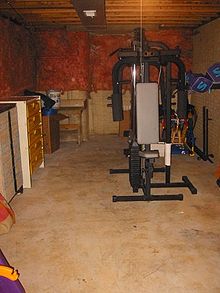
An unfinished basement used for storage and do


A former Stasi basement hallway

Cellars are often used in pubs to go on beer barrels connected to the bar at footing level.
A basement or cellar is 1 or more floors of a building that are completely or partly below the ground floor.[1] It generally is used as a utility space for a building, where such items as the furnace, h2o heater, billow panel or fuse box, car park, and ac system are located; so as well are amenities such every bit the electric organization and cable television distribution betoken. In cities with loftier property prices, such every bit London, basements are oft fitted out to a high standard and used as living space.
In British English, the word basement is used for underground floors of, for example, department stores, just the word is used but with houses when the space below the footing floor is habitable, with windows and (normally) its own admission. The word cellar applies to the whole underground level or to any big underground room. A subcellar is a cellar that lies farther underneath.[two]
Purpose, geography, and history [edit]
A basement can be used in nearly exactly the same manner every bit an additional in a higher place-ground flooring of a house or other building. However, the employ of basements depends largely on factors specific to a particular geographical area such as climate, soil, seismic activity, edifice technology, and real estate economics.
Basements in small buildings such equally unmarried-family unit detached houses are rare in wet climates such every bit Britain and Ireland where flooding can be a problem, though they may be used on larger structures. However, basements are considered standard on all but the smallest new buildings in many places with temperate continental climates such as the American Midwest and the Canadian Prairies where a concrete foundation below the frost line is needed in any case, to prevent a edifice from shifting during the freeze-thaw cycle. Basements are much easier to construct in areas with relatively soft soils and may exist foregone in places where the soil is too compact for easy earthworks. Their utilize may be restricted in earthquake zones, because of the possibility of the upper floors collapsing into the basement; on the other hand, they may be required in tornado-prone areas as a shelter against violent winds. Adding a basement tin can too reduce heating and cooling costs as it is a course of world sheltering, and a way to reduce a building'southward area-to-volume ratio. The housing density of an expanse may besides influence whether or not a basement is considered necessary.
Historically, basements take become much easier to build (in developed countries) since the industrialization of home edifice. Large powered excavation machines such as backhoes and front-end loaders have reduced the time and manpower needed to dig a basement dramatically as compared to digging past manus with a spade, although this method may all the same exist used in the developing world.
For well-nigh of its early history, the basement took i of two forms. It could exist little more than a cellar, or information technology could be a section of a building containing rooms and spaces similar to those of the residue of the structure, as in the case of basement flats and basement offices.
Even so, start with the evolution of big, mid-priced suburban homes in the 1950s, the basement, every bit a space in its own right, gradually took concur. Initially, information technology was typically a large, concrete-floored space, accessed by indoor stairs, with exposed columns and beams along the walls and ceilings, or sometimes, walls of poured physical or concrete cinder cake.
Types [edit]

English basement [edit]
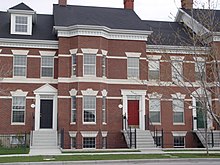
An English language basement, too known as a daylight basement is independent in a house where at least function of the floor goes above basis to provide reasonably-sized windows. More often than not, the floor'due south ceiling should be plenty above ground to provide nearly full-size windows. Some daylight basements are located on slopes, such that one portion of the floor is at-grade with the country. A walk-out basement almost always results from this.
Well-nigh daylight basements naturally result from raised bungalows and at-grade walk-out basements. Nevertheless, there are instances where the terrain dips enough from one side to some other to allow for three/4 to full-size windows, with the actual flooring remaining below grade.
In most parts of North America, it is legal to ready up apartments and legal bedrooms in daylight basements, whether or not the entire basement is above class.
Daylight basements can be used for several purposes—equally a garage, as maintenance rooms, or every bit living space. The buried portion is oft used for storage, laundry room, hot water tanks, and HVAC.
Daylight basement homes typically appraise higher than standard-basement homes, since they include more viable living spaces. In some parts of the U.s., even so, the appraisal for daylight basement space is one-half that of basis and above ground level square footage. Designs accommodated include split-foyer and carve up-level homes. Garages on both levels are sometimes possible. As with whatever multilevel home, there are savings on roofing and foundations.[three] [four]
Walk-out basement [edit]
A walk-out basement is any basement that is partially hugger-mugger but nonetheless allows egress directly outdoors and has floating walls. This can either be through a stairwell leading above basis, or a door straight outside if a portion of the basement is completely at or above grade.
Many walk-out basements are as well daylight basements. The only exceptions are when the entire basement is about entirely underground, and a stairwell leads upwards nearly a flooring'southward worth of vertical height to pb to the outdoors.
By and large, basements with only an emergency get out well do not count as walk-out. Walk-out basements with at-form doors on one side typically are worth a lot more than, only are more plush to construct since the foundation is still constructed to attain beneath the frost line. At-grade walk-out basements on the door-side are often used as livable space for the house, with the buried portion used for utilities and storage.

Subbasement [edit]
A subbasement is a floor below the basement flooring. In the homes where there is any type of basement mentioned higher up, such as a await-out basement, all of the volume of the subbasements from floor to ceiling are located well below basis. Therefore, subbasements accept no windows nor an outside door. In the homes that have subbasements, all of the basement can exist used as part of the principal home where people relax and do recreational things, while all of the subbasement tin can be used for storage. Subbasements are much more common in larger structures, such every bit commercial buildings and larger apartment buildings, than they are in single family homes. It's common for skyscrapers to accept multiple sub basements.[5]
Building a subbasement is more hard, costly, and fourth dimension-consuming than edifice a basement as the everyman floor. Subbasements are even more susceptible to flooding and water harm than basements and are therefore rare, except in dry climates and at higher elevations.
Some famous landmarks contain subbasements. The subbasement of the US Capitol Building is used as storage and that in the White House is used to shop invitee items.
Finished fully underground cellar [edit]

According to the international Oxford Dictionary of English, a finished fully secret cellar is a room below ground level in a business firm that is frequently used for the storage of wine or coal;[6] information technology may also refer to the stock of vino itself. A cellar is intended to remain at a abiding absurd (not freezing) temperature all year round and usually has either a small window/opening or some grade of air ventilation (air/draught bricks, etc.) in order to help eliminate damp or stale air. Cellars are more common in the Britain in older houses, with most terraced housing built during late 19th and early 20th centuries having cellars. These were of import shelters from air raids during World War Ii. In parts of North America that are decumbent to tornadoes (e.grand. Tornado Alley), cellars still serve equally shelter in the event of a direct hit on the firm from a tornado or other storm impairment caused past potent winds.
Except for United kingdom, Australia and New Zealand, cellars are pop in most western countries. In the United Kingdom, almost all new homes built since the 1960s have no cellar or basement due to the extra cost of digging down further into the sub-soil and a requirement for much deeper foundations and waterproof tanking. The contrary has recently become common, where the impact of smaller home-footprints has led to roof-infinite being utilised for further living space and now many new homes are built with third-floor living accommodation. For this reason, especially where lofts have been converted into living space, people tend to use garages for the storage of food freezers, tools, bicycles, garden and outdoor equipment. The majority of continental European houses have cellars,[ citation needed ] although a large proportion of people live in apartments or flats rather than houses. In N America, cellars usually are found in rural or older homes on the coasts and in the South. However, total basements are commonplace in new houses in the Canadian and American Midwest and other areas field of study to tornado activity or requiring foundations below the frost line.
Undercover crawl space [edit]
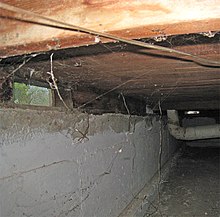
A typical clamber infinite showing clamber infinite vents and concrete rat-proofing. Rat-proofing is a thin, irregular concrete roofing applied over the soil to forbid rodents from burrowing nether the foundation wall and entering the crawl space.
An hush-hush crawl infinite (as the name implies) is a blazon of basement in which one cannot stand up—the top may exist every bit lilliputian as one human foot (xxx cm), and the surface is oftentimes soil. Crawl spaces offering a convenient access to pipes, substructures and a variety of other areas that may be difficult or expensive to access otherwise. While a crawl space cannot be used as living infinite, it tin exist used as storage, ofttimes for infrequently used items. Care must be taken in doing and so, however, as water from the damp ground, water vapour (inbound from crawl space vents), and wet seeping through porous concrete tin can create a perfect environs for mould/mildew to grade on any surface in the crawl space, especially cardboard boxes, forest floors and surfaces, drywall and some types of insulation.
Health and safety problems must be considered when installing a crawl space. As air warms in a dwelling house, it rises and leaves through the upper regions of the house, much in the same way that air moves through a chimney. This phenomenon, called the "stack effect", causes the dwelling house to suck air upward from the crawl space into the main area of the home. Mould spores, decomposition odours, and ***** material from grit mites in the crawl space can come up with the air, aggravating asthma and other breathing issues, and creating a variety of wellness concerns.[7]
It is usually desirable to terminate a crawl space with a plastic vapour barrier that volition not support mold growth or allow humidity from the earth into the crawl infinite. This helps insulate the crawl space and discourages the habitation of insects and vermin by breaking the ecological concatenation in which insects feed off the mould and vermin feed on the insects, likewise as creating a concrete inorganic bulwark that deters archway into the space. Vapour barriers tin can end at the wall or exist run up the wall and fastened to provide fifty-fifty more protection against moisture infiltration. Some pest control agencies recommend against covering the walls, as it complicates their job of inspection and spraying. Almost unheard of as late equally the 1990s, vapour barriers are becoming increasingly popular in recent years.[ when? ] In fact, the more general area of conditioned vs. unconditioned crawl spaces has seen much research over the terminal decade.[ citation needed ]
Dry out rot and other conditions detrimental to buildings (particularly wood and timber structures) tin can develop in enclosed spaces. Providing adequate ventilation is thought to reduce the occurrence of these problems. Crawl infinite vents are openings in the wall which allow air movement. Such vents are usually fitted with metallic grating, mesh, or louvers which can block the movement of rodents and vermin but generally non insects such as termites and carpenter ants. 1 mutual rule is to provide vents in cross exclusive area equal to 1/150 of the floor area served.[viii]
Modern crawl space thinking has reconsidered the usage of crawl space vents in the home.[ix] [10] While clamber space vents practise allow outside air to ventilate into the home, the ability of that air to dry out the crawl space is debatable.[11] In areas with boiling summers, during the summer months, the air vented into a clamber infinite volition be humid, and as it enters the crawl infinite, which has been cooled naturally by the earth, the relative humidity of the air will rising. In those cases, crawl space vents tin even increase the humidity level of a clamber space and lead to condensation on cool surfaces inside, such every bit metallic and forest.[12] In the wintertime, clamber space vents should be shut off entirely, to keep out the cold winter air which tin can cool hot water pipes, furnaces, and water heaters stored inside. During rainy weather, crawl space vents bring moisture air into the crawl space, which will not dry out the space effectively.
Blueprint and structural considerations [edit]

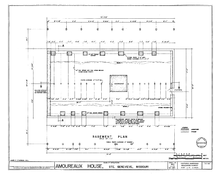


Grocery department in basement of T. Eaton's company, Calgary, Alberta, Canada (1929)
Structurally, for houses, the basement walls typically form the foundation. In warmer climates, some houses do not have basements because they are not necessary (although many withal prefer them). In colder climates, the foundation must be below the frost line. Unless constructed in very cold climates, the frost line is not so deep as to justify an entire level below the ground, although information technology is usually deep enough that a basement is the assumed standard. In places with oddly stratified soil substrata or high water tables, such as well-nigh of Texas, Oklahoma, Arkansas, and areas within 50 miles (80 km) of the Gulf of Mexico, basements are ordinarily not financially viable unless the building is a large apartment or commercial structure.
Digging using a backhoe or excavator is commonly used to dig a basement. If shelf rock is discovered, the need for blasting may be cost prohibitive. Basement walls may demand to have the surrounding world backfilled around them to render the soil to course. A water finish, some gravel and a french bleed may need to be used to prevent h2o from entering the basement at the bottom of the wall. Walls below grade may need to exist sealed with an impervious blanket (such every bit tar) to prevent water seepage. A polyethylene of about half-dozen mil (visqueen) serves as a h2o barrier underneath the basement.
Some designs elect to simply leave a clamber infinite under the house, rather than a full basement due to structural challenges. Most other designs justify farther excavations to create a full-top basement, sufficient for another level of living space. Even so, basements in Canada and the northern Us were typically only 7 feet 10 inches (2.39 k) in elevation, rather than the standard full eight anxiety (2.4 chiliad) of the main floors.[13] Older homes may have even lower basement heights as the basement walls were concrete block and thus, could be customized to any height. Modern builders offer college basements equally an option. The cost of the additional depth of earthworks is usually quite expensive. Thus, houses almost certainly never have multi-storey basements though 9 feet (2.7 m) basements heights are a frequent selection among new home buyers. For large office or apartment buildings in prime number locations, the toll of land may justify multi-storey basement parking garages.
The concrete flooring in most basements is structurally non part of the foundation; merely the basement walls are. If there are posts supporting a main flooring beam to form a mail and beam system, these posts typically go correct through the basement floor to a footing underneath the basement floor. It is the footing that supports the post and the footing is part of the house foundation. Load-bearing wood-stud walls balance direct on the concrete floor. Under the concrete floor is typically gravel or crushed stone to facilitate draining. The flooring is typically 4 inches (100 mm) thick and it rests on top of the foundation footings. The floor is typically sloped towards a drain point, in case of leaks.
Modern construction for basement walls typically falls into one of two categories: they will exist fabricated of poured-in-place concrete using physical forms with a physical pump, or they will use concrete masonry units (block walls). Rock may as well be used, but is less mutual. In monolithic architecture, large parts of the edifice are fabricated of concrete; in insulating concrete form construction, the concrete walls may be hidden with an outside finish or siding. Inside the construction, a single Lally column, steel basement jack, wooden column or support post may hold up the floor above in a small basement. A serial of these supports may be necessary for large basements; many basements have the support columns exposed.
Since warm air rises, basements are typically libation than the remainder of the house. In summertime, this makes basements damp, due to the higher relative humidity. Dehumidifiers are recommended. In winter, additional heating, such as a fireplace or baseboard heaters may be required. A well-defined central heating system may minimize this requirement. Heating ducts typically run in the ceiling of the basement (since there is not an empty floor below to run the ducts). Ducts extending from the ceiling downward to the floor assistance rut the common cold floors of the basement. Older or cheaper systems may simply have the heating vent in the ceiling of the basement.
The finished floor is typically raised off the physical basement floor. In countries such as Canada, laminate flooring is an exception: Information technology is typically separated from the physical by only a thin foam underlay. Radiant heating systems may be embedded within the concrete floor. Even if unfinished and unoccupied, basements are heated in order to ensure relative warmth of the floor above, and to prevent water supply pipes, drains, etc. from freezing and bursting in winter. It is recommended that the basement walls be insulated to the frost line. In Canada, the walls of a finished basement are typically insulated to the floor with vapor barriers to prevent wet transmission. However, a finished basement should avoid wood or forest-laminate flooring, and metal framing and other moisture resistant products should be used. Finished basements can be costly to maintain due to deterioration of waterproofing materials or lateral earth movement etc. Beneath-basis structures will never be as dry every bit ane to a higher place ground, and measures must exist taken to circulate air and dehumidify the surface area.[14]
Drainage considerations [edit]
Basement floor drains that connect to germ-free sewers demand to be filled regularly to prevent the trap from drying out and sewer gas from escaping into the basement. The bleed trap can exist topped up automatically past the condensation from air conditioners or high-efficiency furnaces. A small tube from another downpipe is sometimes used to keep the trap from drying out. Wellness Canada advocates the utilise of special radon gas traps for floor drains that lead to soil or to a sealed sump pump.[15] In areas where storm and germ-free sewers are combined, and there is the take chances of flooding and sewage backing up, backwater valves in all basement drains may exist mandated by code and definitely are recommended even if not mandated.
The main water cutting-off valve is ordinarily in the basement. Basements often have "make clean outs" for the sanitary and storm sewers, where these pipes can be accessed. The tempest sewer access is only needed where the weeping tiles drain into the storm sewers.
Other than with walk-out or wait-out basements, windows in basements crave a well and are below grade. A clear window well encompass may exist required to keep the window wells from accumulating pelting water. There should be drains in the window well, connected to the foundation drains.
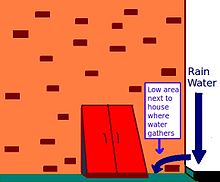
Water can seep into a basement from elevated places nearby, such equally a raised driveway. Solutions include: re-mortaring bricks; silicone in cracks; elevating areas next to outside walls; sloping gutters so water flows away from business firm.
If the water table outside the basement is above the superlative of the basement flooring, and so the foundation drains or the weeping tiles outside the footings may exist bereft to go along the basement dry. A sump pump may be required. It can be located anywhere and is but in a well that is deeper than the basement floor.
Even with functioning sump pumps or low water tables, basements may become moisture afterwards rainfall, due to improper drainage. The basis next to the basement must exist graded such that water flows away from the basement wall. Downspouts from roof gutters should drain freely into the storm sewer or directed away from the house. Downspouts should not exist connected to the foundation draintiles. If the draintiles go clogged by leaves or debris from the pelting gutters, the roof h2o would cause basement flooding through the draintile. Clammy-proofing or waterproofing materials are typically applied to outside of the basement wall. It is virtually impossible to make a concrete wall waterproof, over the long run, then drainage is the key. There are draining membranes that can be applied to the outside of the basement that create channels for water against the basement wall to catamenia to the foundation drains.[16]
Where drainage is inadequate, waterproofing may be needed. There are numerous ways to waterproof a basement, but virtually systems fall into 1 of three categories:
- Tanking – Systems that bond to the basement structure and physically hold back groundwater.
- Crenel Drainage – Dimpled plastic membranes are used to line the floors and walls of the basement, creating a "drained cavity." Whatsoever h2o entering this drained crenel is diverted to a sump pump and pumped away from the basement.
- Exterior Foundation Drain – Installing an outside foundation drain that volition bleed away by gravity is the most effective means to waterproof a basement. An exterior system allows water to menstruation away from the basement without using pumps or electricity. An exterior bleed also allows for the installation of a waterproof membrane to the foundation walls.
The waterproofing organisation can be applied to the inside or the outside walls of a basement.[17] When waterproofing existing basements information technology is much cheaper to waterproof the basement on the inside. Waterproofing on the outside requires the expense of earthworks, but does offer a number of advantages for a homeowner over the long term. Amid them are:
- Gravity system
- No pumps or electrical wiring required
- Membrane applied to exterior walls to preclude dampness, mold, moisture, and soil gases from entering the home
- Permanent solution
Basement culture and finishings [edit]

Example of the outcome of houses constructed in the beginning of the 20th century in Dawson City (Yukon Territory) without a basement.
Unfinished basement [edit]
The unfinished pattern, found principally in spaces larger than the traditional cellar, is mutual in residences throughout the U.Due south. and Canada. I usually finds within information technology a water heater, various pipes running along the ceiling and downwards to the flooring, and sometimes a workbench, a freezer or refrigerator, or a washer/dryer set. Boxes of various materials, and objects unneeded in the rest of the house, are also oft stored in that location; in this regard, the unfinished basement takes the place both of the cellar and of the attic. Habitation workshops are frequently located in the basement, since sawdust, metal chips, and other mess or racket are less of a nuisance there. The basement can contain all of these objects and all the same be considered to be "unfinished", equally they are either generally or entirely functional in purpose.
Finished basement [edit]

In this case the space has been designed, either during construction or at a later on signal by the owners, to function as a fully habitable addition to the house. Often about or all of the basement is used as a recreation room or living room, but it is not uncommon as well to find there (either instead of or aslope the living/recreation room) a guest bedroom or teenager'south room, a bath, a home function, a home gym, a home theater, a basement bar, a sauna, craft room, play room, kitchenette, and one or more than closets.[18] Occasionally a part of the basement is unfurnished and is used for storage, a workshop, and/or a laundry room; when this is the case the water heater and furnace will besides often exist located there, although in some cases the entire basement is finished, and the water heater and furnace are boxed off into a closet.
Partially finished basement [edit]
The principal point of distinction betwixt this type of basement and the two others lies in its being either entirely unmodified (different the finished basement) beyond the addition of furniture, recreational objects and appliances, and/or practise equipment on the bare floor, or slightly modified through the installation (also any or all of the aforementioned items) of loose rug and perchance simple low-cal fixtures. In both cases, the objects constitute at that place—many of which could be found in a finished basement besides—might include the post-obit: weight sets and other do equipment; the boom boxes or amusement systems used during exercise; musical instruments (which are not in storage, as they would technically exist in an unfinished basement; an assembled drum set would exist the almost easily identified of these); football tables, chairs, couches and entertainment appliances of bottom quality than those in the residue of the house; refrigerators, stand-alone freezers, and microwaves (the showtime and the second being also sometimes used equally supplementary storage units in an unfinished basement); and sports pennants and/or other types of posters which are attached to the walls.
Every bit the description suggests, this type of basement, which also might exist called "one-half-finished", is likely used by teenagers and children. The unabridged family unit might utilize a piece of work-out area. It is likewise mutual to take a secondary (or principal) dwelling house office in a partially finished basement, besides equally a workbench and/or a space for laundry appliances.
Toilets and showers sometimes exist in this variety of basement, every bit many North American basements are designed to allow for their installation.
Fully finished basement – retro fit [edit]
In London the construction of finished retrofit basements is big business with a large number of projects in the 100–200 foursquare meter subclass. There are a smaller number of projects in the 200–500 square meter subclass nether construction. Information technology is as well not unusual to see multi-level retrofit basements. These are considerable works of civil engineering and crave some skill and intuitive agreement too every bit good engineering. Some of the more than grandiose of these basement projects accept been widely reported in the national media, including the "Witanhurst" project in the Highgate expanse of London.[19] and the huge iceberg-like homes which are outset to be constructed in prime London areas such as Kensington and Chelsea.[20]
Use in hospitals [edit]
Hospitals often place their nuclear chemistry and radiation therapy and diagnostic resources in basements to utilize the shielding from the earth.
Real estate floorspace measures [edit]
In Canada, historically the basement area was excluded from advertised foursquare footage of a house as it was not part of the living infinite. For example, a "2,000-square-foot bungalow" would, in reality, have 4,000 square feet (370 m2) of floor space. More than recently, finished space has become increasingly acceptable every bit a measure which includes the developed basement areas of a habitation. Due to burn down lawmaking requirements, most jurisdictions require an emergency egress (through either egress-way windows, or, in the case of a walk-out basement, a door) to include the basement square footage as living space.
See too [edit]
- Coal hole
- Loft conversions in the Britain
References [edit]
- ^ "Basement - FEMA.gov". www.fema.gov.
- ^ Subcellar – definition of Subcellar past the Free Online Dictionary, Thesaurus and Encyclopedia.
- ^ Woodson, R. Contrivance. Build Your Dream Home for Less. Cincinnati: Betterway Books, 1985, pp 60–61.
- ^ Zeller, Dirk. Success as a Real Estate Amanuensis for Dummies. Wiley, 2006, p. 209
- ^ Poulos, Harry G. (2016). "Tall building foundations: Design methods and applications". Innovative Infrastructure Solutions. 1. doi:10.1007/s41062-016-0010-2.
- ^ Soanes, Catherine and Stevenson, Angus (ed.) (2005). Oxford Lexicon of English language, 2nd Ed., revised, Oxford University Press, Oxford, New York, p. 278. ISBN 978-0-nineteen-861057-ane.
- ^ "Mold Allergies". Healthlink.mcw.edu. 22 July 2022. Archived from the original on 22 Jan 2009. Retrieved 2 Nov 2022.
- ^ 2003 International Building Code, Section 1203.3, International Code Quango
- ^ "To Vent or Not to Vent" (PDF). advancedenergy.org. Retrieved 3 July 2009.
- ^ "Crawl Space Insulation". The states Dept. of Free energy. Archived from the original on 3 July 2009. Retrieved 3 July 2009.
- ^ "Closed clamber spaces practice double duty" (PDF). advancedenergy.org. Archived from the original (PDF) on 24 January 2009. Retrieved three July 2009.
- ^ "Closing the crawl" (PDF). Builder magazine Oct 2005 (reproduced past advancedenergy.org). Archived from the original (PDF) on 10 February 2009. Retrieved iii July 2009.
- ^ Rose, Judy (21 April 2002). "The Hole Story: Business firm construction starts with earthworks out the basement and pouring its physical walls". Detroit Free Press. Archived from the original on 2 June 2002. Retrieved 24 May 2022.
- ^ "Full Height Basement Insulation and Drainage Layer Requirements". Ontario: Ministry of Municipal Affairs and Housing. xx August 1996 [30 June 2003]. Archived from the original on 15 August 2004. Retrieved 24 May 2022.
- ^ Canada, Health. "Radon - Reduction Guide for Canadians - Canada.ca". world wide web.hc-sc.gc.ca.
- ^ "Basement Waterproofing". Window Well Experts . Retrieved vi October 2022.
- ^ "Signs of a Leaky Basement & Basement Waterproofing Issues". Archived from the original on 23 January 2022.
- ^ "Finishing and Remodeling a Basement". Basement Finishing Omaha.
- ^ "£100m? Not such a deal basement". London Evening Standard. 21 June 2022.
- ^ "Deep Concerns: The trouble with basement conversions". The Guardian. eighteen August 2022.
External links [edit]
 | Wikimedia Commons has media related to Basements. |
- . Encyclopædia Britannica. Vol. iii (11th ed.). 1911.
- National Research Quango (Canada) Basement bailiwick search
- HealthLink's Article on Mold Allergies
- RedRock Basement Builders

Source: https://en.wikipedia.org/wiki/Basement
Posted by: lunasearly1971.blogspot.com
0 Response to "How To Repair A Basement Floor That Has Water When It Rains"
Post a Comment